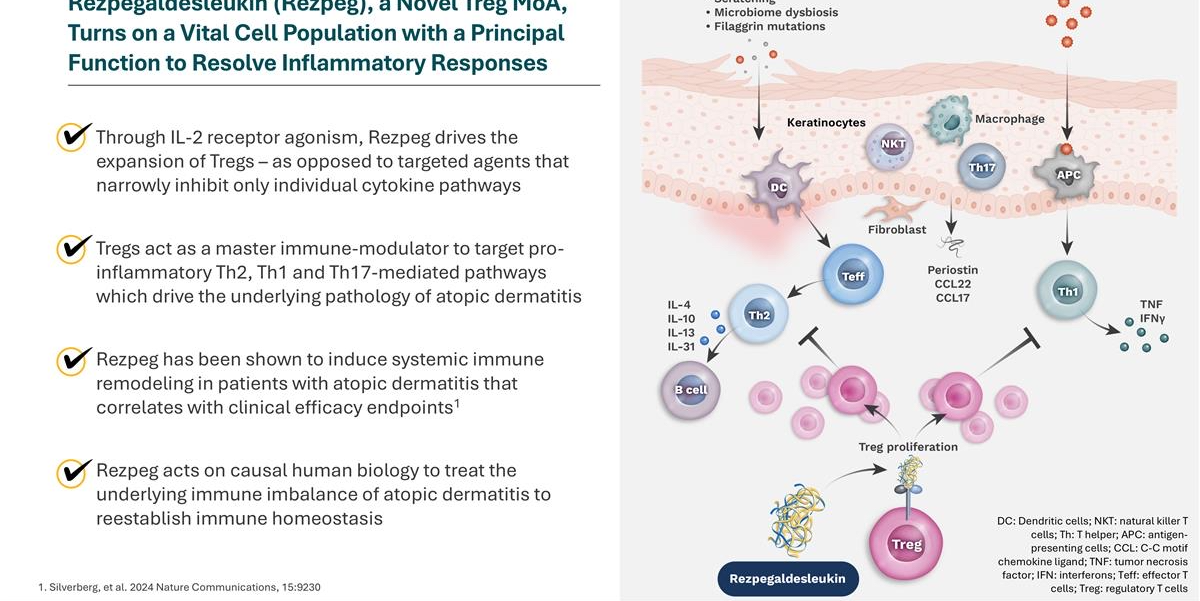
Most modern targeted treatments for atopic dermatitis work by blocking something: a cytokine, receptor or signalling pathway involved in inflammation. Rezpegaldesleukin is exploring a different idea.
Instead of mainly blocking inflammatory signals, the investigational treatment is designed to increase the activity of »regulatory T cells«, or Tregs — immune cells that help control excessive immune responses and maintain immune balance.
In August 2026, Nektar Therapeutics announced publication of results from the Phase 2b »REZOLVE-AD« trial in The Lancet. The international, randomised, double-blind, placebo-controlled trial evaluated rezpegaldesleukin in adults with moderate-to-severe atopic dermatitis. Participants received one of several dosing regimens or placebo during a 16-week induction period.
According to Nektar, the study met its primary and key secondary endpoints. mprovements were observed across several commonly used atopic dermatitis measures, including EASI-75 and EASI-90, representing at least 75% and 90% improvements in the Eczema Area and Severity Index. The study also assessed itch, investigator global assessment scores and the percentage of body surface area affected by atopic dermatitis.
What makes the programme particularly interesting scientifically is its mechanism. Rezpegaldesleukin acts on the interleukin-2 receptor system in a way intended to selectively expand regulatory T cells.
Tregs help prevent immune reactions from becoming excessively active and play an important role in maintaining immune tolerance. Researchers therefore hope that increasing their activity could restore immune balance more “upstream” than therapies blocking individual inflammatory cytokines.
That does not mean the medicine has been shown to provide better or more durable disease control than existing biologics or JAK inhibitors. Phase 2 trials provide important information about efficacy, dose and safety, but larger Phase 3 programmes are necessary before regulatory approval can be considered. Nektar has already moved the programme forward into Phase 3 development. That is important because researchers are interested not only in whether skin and itch improve, but in whether modulation of regulatory T cells could change broader immune activity. If the approach succeeds in later-stage trials, it could add a genuinely different treatment mechanism to the atopic dermatitis landscape.
That diversity matters.
Atopic dermatitis is biologically heterogeneous, and no available medicine works optimally for every patient. Rezpegaldesleukin remains investigational. But REZOLVE-AD shows that researchers are no longer only asking which inflammatory signal should be blocked next. They are also asking whether the immune system itself can be encouraged to regulate inflammation more effectively.