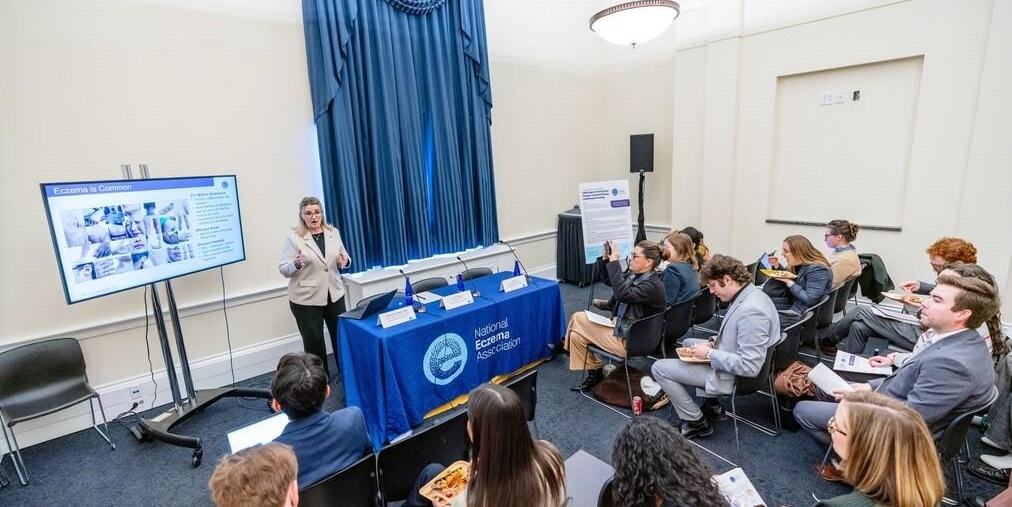
Patient advocacy can sometimes sound abstract. In September 2026, the National Eczema Association (NEA) turned it into something very concrete: 61 meetings with congressional offices in two days — followed by an early legislative result.
Beginning on 23 September, 30 NEA Ambassadors representing 20 U.S. states joined the organisation's fourth annual Virtual Hill Day. Patient advocates held 36 meetings with Senate offices and 25 with House offices, reaching lawmakers from 19 states and Washington, D.C. For more than a third of the participating ambassadors, it was their first time taking part.
The purpose was not simply to explain what eczema is. Advocates shared what it actually means to manage a chronic inflammatory skin disease and brought those experiences directly into policy discussions.
And shortly after one of those meetings, something tangible happened. U.S. Senator John Fetterman of Pennsylvania became a cosponsor of the Safe Step Act. The legislation addresses step therapy, a process through which insurers may require patients to try and fail other treatments before covering the medicine their healthcare professional originally prescribed.
For someone with uncontrolled eczema, those requirements can mean additional months of symptoms while navigating treatment barriers. The Safe Step Act would establish a clearer process through which patients and healthcare professionals can request exceptions.
NEA Ambassadors also advocated for the HELP Copays Act, continued inclusion of eczema in the Department of Defense Peer-Reviewed Medical Research Program and support for National Institutes of Health research funding.
That illustrates how patient organisations are becoming increasingly professional participants in healthcare policy. Their role is no longer limited to support groups and awareness campaigns. Patient organisations contribute to research priorities, regulatory discussions, reimbursement debates and legislation.
For eczema, that involvement is particularly important because much of the burden is invisible. Clinical measures can document body surface area and lesion severity. They do not fully capture lost sleep, difficulty concentrating, stigma, treatment costs or the amount of time families spend managing the disease.
Policymakers may never see those consequences unless patients tell them. NEA's Hill Day created a direct route for that conversation.
Sixty-one congressional meetings will not transform eczema care overnight. But the new Safe Step Act cosponsorship provides a concrete example of how organised patient advocacy can move beyond awareness. It can put lived experience directly in front of decision-makers — and sometimes, the person listening takes action.